
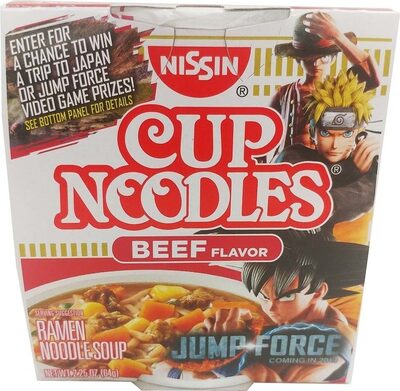
Cup Noodles Beef Soup
Health
Nutrition
Nutri-Score
 Lower nutritional quality
Nutri-Score data warning
Nutrient levels
Fat in moderate quantity (17.2%)
Saturated fat in high quantity (7.81%)
Sugars in low quantity (3.13%)
Salt in high quantity (4.49%)
Nutrition label
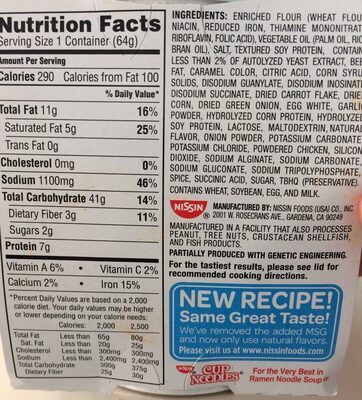
Nutrition facts
| Nutrition facts | As sold for 100 g / 100 ml | Compared to: Instant noodles |
|---|---|---|
| Energy | ~ 1935.9375 kJ (453 kcal) | 1,156.245 kJ (278 kcal) (+67%) |
| Fat | 17.1875 g | 10.047 g (+71%) |
| Saturated fat | 7.8125 g | 4.304 g (+82%) |
| Trans fat | ? | 0.01 g |
| Cholesterol | ? | 0.904 mg |
| Carbohydrates | 64.0625 g | 38.512 g (+66%) |
| Sugars | 3.125 g | 2.429 g (+29%) |
| Added sugars | ~ 1.43752077647618 g | 1.035 g (+39%) |
| Dietary fiber | 3.125 g | ? |
| Proteins | 10.9375 g | 6.074 g (+80%) |
| Salt | 4.4921875 g | 2.356 g (+91%) |
| Sodium | 1.796875 g | 0.941 g (+91%) |
| Vitamin D | ? | 0.117 µg |
| Potassium | ? | 215.323 mg |
| Calcium | ? | 32.532 mg |
| Iron | ? | 1.849 mg |
| Fruits, vegetables and legumes | ~ 2.875 % | ? |
Nutrition facts (Detailed data)
| Nutrition facts | As sold for 100 g / 100 ml | As sold Per serving (64 g) (packaging) | As sold Per 100 g (estimate) |
|---|---|---|---|
| Energy | ~ 1935.9375 kJ (453 kcal) | ? (290 kcal) | ? |
| Fat | 17.1875 g | 11 g | ? |
| Saturated fat | 7.8125 g | 5 g | ? |
| Trans fat | ? | ? | ? |
| Cholesterol | ? | ? | ? |
| Carbohydrates | 64.0625 g | 41 g | ? |
| Sugars | 3.125 g | 2 g | ? |
| Added sugars | ~ 1.43752077647618 g | ? | ~ 1.43752077647618 g |
| Dietary fiber | 3.125 g | 2 g | ? |
| Proteins | 10.9375 g | 7 g | ? |
| Salt | 4.4921875 g | 2.875 g | ? |
| Sodium | 1.796875 g | 1.15 g | ? |
| Vitamin D | ? | ? | ? |
| Potassium | ? | ? | ? |
| Calcium | ? | ? | ? |
| Iron | ? | ? | ? |
| Fruits, vegetables and legumes | ~ 2.875 % | ? | ~ 2.875 % |
Serving size
Ingredients
Ingredients image
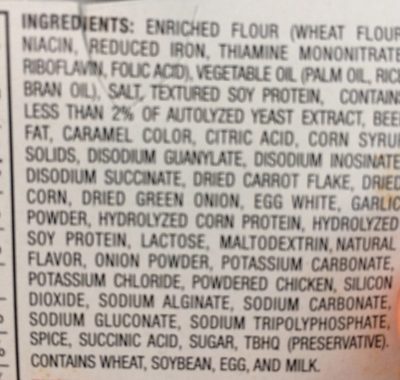
Ingredients list
Ingredient information
Added sugars
Allergens
Ingredients analysis
Contains ingredients containing palm oil.
Contains non-vegan ingredients.
Unrecognized: en:contains-less-than-2-of-autolyzed-yeast-extract, en:disodium-succinate
Contains non-vegetarian ingredients.
Unrecognized: en:contains-less-than-2-of-autolyzed-yeast-extract, en:disodium-succinate
Food Processing
NOVA group
 Ultra-processed food and drink products
Elements that indicate the product is in NOVA group 4
How NOVA works
Additives
E150c - Ammonia caramel EFSA overexposure risk: moderateColour
No additive description is available yet.
E319 - Tertiary-butylhydroquinone (tbhq)Antioxidant
tert-Butylhydroquinone (TBHQ, tertiary butylhydroquinone) is a synthetic aromatic organic compound which is a type of phenol. It is a derivative of hydroquinone, substituted with a tert-butyl group.
E330 - Citric acidAntioxidantSequestrant
Citric acid is a natural organic acid found in citrus fruits such as lemons, oranges, and limes.
It is widely used in the food industry as a flavor enhancer, acidulant, and preservative due to its tart and refreshing taste.
Citric acid is safe for consumption when used in moderation and is considered a generally recognized as safe (GRAS) food additive by regulatory agencies worldwide.
E363 - Succinic acid
Succinic acid () is a dicarboxylic acid with the chemical formula (CH2)2(CO2H)2. The name derives from Latin succinum, meaning amber. In living organisms, succinic acid takes the form of an anion, succinate, which has multiple biological roles as a metabolic intermediate being converted into fumarate by the enzyme succinate dehydrogenase in complex 2 of the electron transport chain which is involved in making ATP, and as a signaling molecule reflecting the cellular metabolic state. Succinate is generated in mitochondria via the tricarboxylic acid cycle (TCA), an energy-yielding process shared by all organisms. Succinate can exit the mitochondrial matrix and function in the cytoplasm as well as the extracellular space, changing gene expression patterns, modulating epigenetic landscape or demonstrating hormone-like signaling. As such, succinate links cellular metabolism, especially ATP formation, to the regulation of cellular function. Dysregulation of succinate synthesis, and therefore ATP synthesis, happens in some genetic mitochondrial diseases, such as Leigh syndrome, and Melas syndrome, and degradation can lead to pathological conditions, such as malignant transformation, inflammation and tissue injury.
E401 - sodium alginateCarrierEmulsifierHumectantSequestrantStabiliserThickener
No additive description is available yet.
E452 - Polyphosphates EFSA overexposure risk: highEmulsifierHumectantSequestrantStabiliserThickener
No additive description is available yet.
E452vi - Sodium tripolyphosphateEmulsifierHumectantSequestrantStabiliserThickener
No additive description is available yet.
E627 - Disodium guanylate
Disodium guanylate, also known as sodium 5'-guanylate and disodium 5'-guanylate, is a natural sodium salt of the flavor enhancing nucleotide guanosine monophosphate (GMP). Disodium guanylate is a food additive with the E number E627. It is commonly used in conjunction with glutamic acid. As it is a fairly expensive additive, it is not used independently of glutamic acid; if disodium guanylate is present in a list of ingredients but MSG does not appear to be, it is likely that glutamic acid is provided as part of another ingredient such as a processed soy protein complex. It is often added to foods in conjunction with disodium inosinate; the combination is known as disodium 5'-ribonucleotides. Disodium guanylate is produced from dried seaweed and is often added to instant noodles, potato chips and other snacks, savory rice, tinned vegetables, cured meats, and packaged soup.
E631 - Disodium inosinate
Disodium inosinate (E631) is the disodium salt of inosinic acid with the chemical formula C10H11N4Na2O8P. It is used as a food additive and often found in instant noodles, potato chips, and a variety of other snacks. Although it can be obtained from bacterial fermentation of sugars, it is often commercially prepared from animal sources.
Environment
Green-Score, origins bonus, and transportation impact are shown for Worldwide .
Green Score
Overall grade
 Unknown environmental impact
About Green-Score
Current scope
Green-Score availability
Bonuses and maluses
Declared origins
Threatened species risk
Packaging impact
Packaging
Packaging impact
Data precision
Transportation
Declared origins
Forest footprint
Forest footprint
Ingredients linked to forest pressure
| Ingredient | Type | Percent in product | Forest footprint |
|---|---|---|---|
| EGG White | Oeufs Importés | 1.44 % | 0.00 |
| Chicken | Poulet Importé | 0.01 % | 0.00 |
Data Source
Product data comes from Open Food Facts. Food Benchmark also adds translations, category comparisons and explanatory calculations.
The database is licensed under ODbL 1.0, individual contents under DbCL 1.0, and product photos under CC BY-SA 3.0.
Product added on March 9, 2017 at 2:26:44 PM UTC by usda-ndb-import .
Last edit on March 17, 2026 at 11:26:08 AM UTC by new-nutrition-bot .
Product page also edited by ecoscore-impact-estimator, foodless, inf, kiliweb, macrofactor, new-nutrition-bot, openfoodfacts-contributors, org-database-usda, usda-ndb-import, yuka.YUxFU1BJTWorUHBUdWZZUzV4L1JwOEI1MTRUNGRqaW5NZFVmSWc9PQ, yuka.sY2b0xO6T85zoF3NwEKvlhNJdOj5nh7GaRzvi063346QErDqQdNu3a2iIas.
Source List
- usda-ndb
- database-usda