

Peanut Butter Filled Pretzel Nuggets
Labels
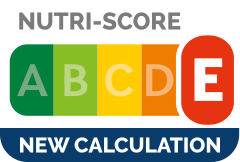 Bad nutritional quality
 Ultra-processed food and drink products
 Not computed
Health
Nutrition
Serving Size
Nutri-Score label
Bad nutritional qualityNutrient levels for 100 g
Fat in moderate quantity (20 g, 20%)
What you need to know
A high consumption of fat, especially saturated fats, can raise cholesterol, which increases the risk of heart diseases.
Recommendation: Limit the consumption of fat and saturated fat
Choose products with lower fat and saturated fat content.
Saturated fat in moderate quantity (3.33 g, 3.33%)
What you need to know
A high consumption of fat, especially saturated fats, can raise cholesterol, which increases the risk of heart diseases.
Recommendation: Limit the consumption of fat and saturated fat
Choose products with lower fat and saturated fat content.
Sugars in moderate quantity (6.67 g, 6.67%)
What you need to know
A high consumption of sugar can cause weight gain and tooth decay. It also augments the risk of type 2 diabetes and cardio-vascular diseases.
Recommendation: Limit the consumption of sugar and sugary drinks
Sugary drinks should be limited as much as possible. Choose products with lower sugar content.
Salt in high quantity (2.75 g, 2.75%)
What you need to know
A high consumption of salt (or sodium) can cause raised blood pressure, which can increase the risk of heart disease and stroke.
Recommendation: Limit the consumption of salt and salted food
Reduce the quantity of salt used when cooking. Limit the consumption of salty snacks.
Nutrition Facts
| Nutrition Facts | As sold for 100 g / 100 ml | Per serving 10 pretzels (30 g) |
|---|---|---|
| Energy | 467 kcal | 140 kcal |
| Fat | 20 g | 6 g |
| Saturated fat | 3.33 g | 1 g |
| Carbohydrates | 56.7 g | 17 g |
| Sugars | 6.67 g | 2 g |
| Dietary fiber | 3.33 g | 1 g |
| Proteins | 16.7 g | 5 g |
| Salt | 2.75 g | 0.83 g |
| Sodium | 1.1 g | 0.33 g |
Ingredients
Ingredients List
Ingredient Information
Food Processing
NOVA Group label
Ultra-processed food and drink productsElements that indicate the product is in the NOVA group 4:
- Additives: E471 - Mono- and diglycerides of fatty acids
The NOVA classification assigns food products into 4 groups based on their degree of processing:
- Unprocessed or minimally processed foods
- Processed culinary ingredients
- Processed foods
- Ultra-processed food and drink products
Ingredients analysis
Palm oil free
Palm oil content unknown
Vegan
Vegan status unknown
Unrecognized ingredients: en:reduced-iron, en:folio-acid, en:amnionium-bicarbonate
Vegetarian
Vegetarian status unknown
Unrecognized ingredients: en:reduced-iron, en:folio-acid, en:amnionium-bicarbonate
Additives
E471 - Mono- and diglycerides of fatty acidsEmulsifierStabiliser
Mono- and diglycerides of fatty acids (E471), are food additives commonly used as emulsifiers in various processed foods.
These compounds consist of glycerol molecules linked to one or two fatty acid chains, which help stabilize and blend water and oil-based ingredients. E471 enhances the texture and shelf life of products like margarine, baked goods, and ice cream, ensuring a smooth and consistent texture.
It is generally considered safe for consumption within established regulatory limits.
E500 - Sodium carbonatesStabiliserThickener
Sodium carbonates (E500) are compounds commonly used in food preparation as leavening agents, helping baked goods rise by releasing carbon dioxide when they interact with acids.
Often found in baking soda, they regulate the pH of food, preventing it from becoming too acidic or too alkaline. In the culinary world, sodium carbonates can also enhance the texture and structure of foods, such as noodles, by modifying the gluten network.
Generally recognized as safe, sodium carbonates are non-toxic when consumed in typical amounts found in food.
E500ii - Sodium hydrogen carbonateStabiliserThickener
Sodium hydrogen carbonate, also known as E500ii, is a food additive commonly used as a leavening agent.
When added to recipes, it releases carbon dioxide gas upon exposure to heat or acids, causing dough to rise and resulting in a light, fluffy texture in baked goods.
It is generally recognized as safe (GRAS) by regulatory authorities when used in appropriate quantities and poses no significant health risks when consumed in typical food applications.
Environment
Environmental score label
Not computedCarbon footprint
No carbon footprint data is available for this product.
Packaging
No packaging information provided.
Transportation and origins
Origins of ingredients
No origin information provided.
Manufacturing places
No manufacturing place information provided.
Environmental labels
No environmental labels identified.
Data Source
Product added on April 15, 2016 at 3:10:06 PM UTC by pitajay .
Last edit on January 27, 2026 at 11:33:06 PM UTC by macrofactor .
Product page also edited by kiliweb, kjmj, lindac, lukasday, macrofactor, municorn-calorie-counter-app, pitajay, usda-ndb-import, yuka.WUlNeUVJbGF2dWM2dGNOZzN5N3VvZjF3M3B1QWZGbVBBTE5JSUE9PQ, yuka.sY2b0xO6T85zoF3NwEKvlnAcY8rm_yn5ED_fwU-m5-uOcYbtcMhK2qv6M6s.
Source List