
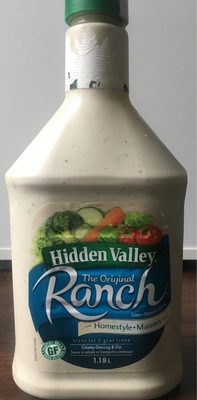
The original ranch
Labels
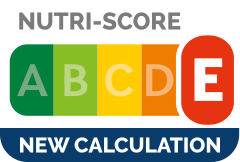 Bad nutritional quality
 Ultra-processed food and drink products
 High environmental impact
Health
Nutrition
Label
Bad nutritional qualityNutrient levels
Fat in high quantity (40%)
Saturated fat in high quantity (6.67%)
Sugars in low quantity (3.33%)
Salt in high quantity (2.17%)
Nutrition label
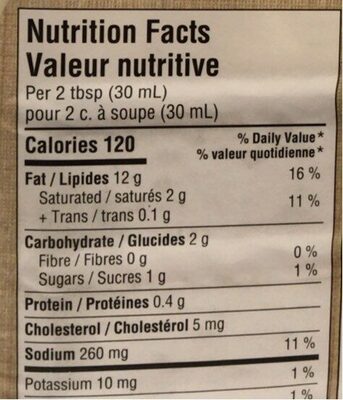
Nutrition facts
| Nutrition facts | As sold for 100 ml |
|---|---|
| Energy | ~ 1,616 kJ (400 kcal) |
| FAT | 40 g |
| Saturated fat | 6.67 g |
| Trans fat | 0 g |
| Cholesterol | 0.03 g |
| Carbohydrates | 6.67 g |
| Sugars | 3.33 g |
| Dietary fiber | 0 g |
| Proteins | 1.33 g |
| Salt | 2.17 g |
| Sodium | 0.87 g |
| Vitamins | |
| Vitamin A | 0 g |
| Vitamin C | 0 g |
| Minerals | |
| Calcium | 0.13 g |
| Iron | 0 g |
| Fruits, vegetables and legumes | ~ 2.17 % |
Nutrition facts (Detailed data)
| Nutrition facts | As sold for 100 ml | As sold Per 100 ml (packaging) | As sold Per 100 g (estimate) |
|---|---|---|---|
| Energy | ~ 1,616 kJ (400 kcal) | ? (400 kcal) | ? |
| FAT | 40 g | 40 g | ? |
| Saturated fat | 6.67 g | 6.67 g | ? |
| Trans fat | 0 g | 0 g | ? |
| Cholesterol | 0.03 g | 0.03 g | ? |
| Carbohydrates | 6.67 g | 6.67 g | ? |
| Sugars | 3.33 g | 3.33 g | ? |
| Added sugars | ~ 1.67 g | ? | ~ 1.67 g |
| Dietary fiber | 0 g | 0 g | ? |
| Proteins | 1.33 g | 1.33 g | ? |
| Salt | 2.17 g | 2.17 g | ? |
| Sodium | 0.87 g | 0.87 g | ? |
| Vitamins | |||
| Vitamin A | 0 g | 0 g | ? |
| Vitamin C | 0 g | 0 g | ? |
| Minerals | |||
| Calcium | 0.13 g | 0.13 g | ? |
| Iron | 0 g | 0 g | ? |
| Fruits, vegetables and legumes | ~ 2.17 % | ? | ~ 2.17 % |
Serving size
Estimated Activity Time
Approximate time needed to burn the energy in 100 g / 100 ml: 1,616 kJ. Reference adult weight: 70 kg. Energy density: Moderate.
Ingredients
Ingredients image
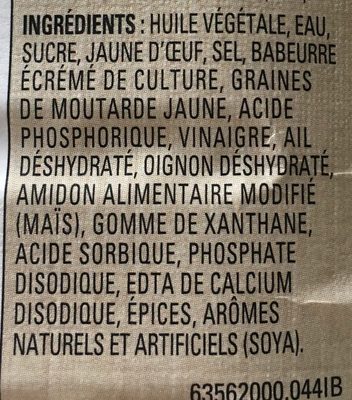
Ingredients list
Ingredient information
Allergens
Ingredients analysis
Palm oil content unknown
Vegan status unknown
Unrecognized: fr:jaune-d-euf, fr:babeurre-ecreme-de-culture
Vegetarian status unknown
Unrecognized: fr:jaune-d-euf, fr:babeurre-ecreme-de-culture
Food Processing
NOVA group
Ultra-processed food and drink productsElements that indicate the product is in NOVA group 4
How NOVA works
Additives
E200 - Sorbic acidPreservative
SORBIC ACID, or 2,4-hexadienoic acid, is a natural organic compound used as a food preservative. It has the chemical formula CH3(CH)4CO2H.
E338 - Phosphoric acidAntioxidantSequestrant
Phosphoric acid (also known as orthophosphoric acid or phosphoric(V) acid) is a weak acid with the chemical formula H3PO4. Orthophosphoric acid refers to phosphoric acid, which is the IUPAC name for this compound. The prefix ortho- is used to distinguish the acid from related phosphoric acids, called polyphosphoric acids. Orthophosphoric acid is a non-toxic acid, which, when pure, is a solid at room temperature and pressure. The conjugate base of phosphoric acid is the dihydrogen phosphate ion, H2PO−4, which in turn has a conjugate base of hydrogen phosphate, HPO2−4, which has a conjugate base of phosphate, PO3−4. Phosphates are essential for life.The most common source of phosphoric acid is an 85% aqueous solution; such solutions are colourless, odourless, and non-volatile. The 85% solution is a syrupy liquid, but still pourable. Although phosphoric acid does not meet the strict definition of a strong acid, the 85% solution is acidic enough to be corrosive. Because of the high percentage of phosphoric acid in this reagent, at least some of the orthophosphoric acid is condensed into polyphosphoric acids; for the sake of labeling and simplicity, the 85% represents H3PO4 as if it were all in the ortho form. Dilute aqueous solutions of phosphoric acid exist in the ortho form.
E339ii - Disodium phosphateEmulsifierHumectantPreservativeSequestrantStabiliserThickener
No additive description is available yet.
E385 - Calcium disodium ethylenediaminetetraacetateAntioxidantPreservativeSequestrant
No additive description is available yet.
E415 - Xanthan gumEmulsifierStabiliserThickener
Xanthan gum (E415) is a natural polysaccharide derived from fermented sugars, often used in the food industry as a thickening and stabilizing agent.
This versatile food additive enhances texture and prevents ingredient separation in a wide range of products, including salad dressings, sauces, and gluten-free baked goods.
It is considered safe for consumption even at high intake amounts.
Environment
Green-Score, origins bonus, and transportation impact are shown for Worldwide .
Green Score
Overall grade
High environmental impactAbout Green-Score
Current scope
Life cycle analysis
Average impact of the category
 Salad dressing, prepacked • Score: 58/100
Life-cycle reference
Overall environmental impact by stage (PEF)
The overall environmental impact figure (PEF) comes from ADEME's Agribalyse database, for the category: Salad dressing, prepacked. Source: ADEME Agribalyse Database.
| Stage | Impact |
|---|---|
| Agriculture | 68.6 % |
| Processing | 11.3 % |
| Packaging | 11.6 % |
| Transportation | 5.8 % |
| Distribution | 2.3 % |
| Consumption | 0.6 % |
Bonuses and maluses
Declared origins
Packaging impact
Green-Score for this product
Green-Score for this product
Final score: 43/100Final score breakdown
Carbon footprint
Carbon footprint
Climate impact by stage (CO2e)
The carbon emission figure comes from ADEME's Agribalyse database, for the category: Salad dressing, prepacked. Source: ADEME Agribalyse Database.
| Stage | Impact |
|---|---|
| Agriculture | 59.7 % |
| Processing | 12.1 % |
| Packaging | 13.7 % |
| Transportation | 12.4 % |
| Distribution | 1.8 % |
| Consumption | 0.3 % |
Packaging
Packaging impact
Packaging materials
| Material | % | Packaging weight | Packaging weight per 100 g of product |
|---|---|---|---|
| Plastic | |||
| Total |
Declared packaging
Transportation
Declared origins
Data Source
Data presented on this page is sourced from the Open Food Facts database. This platform does not alter the original dataset; its purpose is solely to enhance data visualization and user accessibility.
Product added on March 10, 2017 at 11:03:19 AM UTC by usda-ndb-import .
Last edit on March 16, 2026 at 11:50:41 PM UTC by new-nutrition-bot .
Product page also edited by ecoscore-impact-estimator, inf, kiliweb, new-nutrition-bot, norm39, openfoodfacts-contributors, org-database-usda, roboto-app, usda-ndb-import, yuka.IpBBIIKnOc8FHt3c87oexCSHL83pUvVWKn8_og, yuka.YXFZNEVhSWlwY2tJbk5obTRRbkx3NHRveko2M2JHUzNOY3dOSVE9PQ, yuka.sY2b0xO6T85zoF3NwEKvlhN7Uv3d_GLEGgDUgBPW4NOOfpnifIFizrjfNas.
Source List
- usda-ndb
- database-usda