
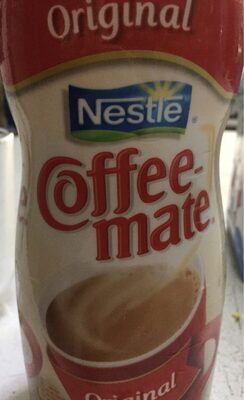
Nestle, Coffee Mate 170g
Health
Nutrition
Nutrition facts
| Nutrition facts | As sold for 100 g / 100 ml | Compared to: Instant coffees |
|---|---|---|
| Energy | ~ 72.7 kJ (15 kcal) | 915.537 kJ (213 kcal) (-92%) |
| Fat | 1 g | 3.887 g (-74%) |
| Saturated fat | 0 g | 2.339 g (-100%) |
| Carbohydrates | 2 g | 33.599 g (-94%) |
| Sugars | 0 g | 14.634 g (-100%) |
| Dietary fiber | 0 g | ? |
| Proteins | 0.1 g | 7.247 g (-99%) |
| Salt | 0 g | 0.295 g (-100%) |
| Sodium | 0 g | 0.116 g (-100%) |
| Fruits, vegetables and legumes | ~ 0 % | ? |
Nutrition facts (Detailed data)
| Nutrition facts | As sold for 100 g / 100 ml | As sold Per 100 g (packaging) | As sold Per 100 g (estimate) |
|---|---|---|---|
| Energy | ~ 72.7 kJ (15 kcal) | ? (15 kcal) | ? |
| Fat | 1 g | 1 g | ? |
| Saturated fat | 0 g | 0 g | ? |
| Carbohydrates | 2 g | 2 g | ? |
| Sugars | 0 g | 0 g | ? |
| Dietary fiber | 0 g | 0 g | ? |
| Proteins | 0.1 g | 0.1 g | ? |
| Salt | 0 g | 0 g | ? |
| Sodium | 0 g | 0 g | ? |
| Fruits, vegetables and legumes | ~ 0 % | ? | ~ 0 % |
Ingredients
Ingredients image
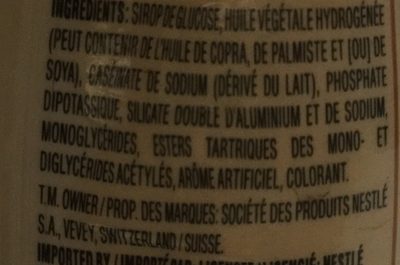
Ingredients list
Ingredient information
Added sugars
Allergens
Ingredients analysis
Contains ingredients containing palm oil.
Contains non-vegan ingredients.
Unrecognized: fr:derive-du-lait, fr:silicate-double-d-aluminium, fr:monoglycerides, fr:esters-tartriques-des-mono-et-diglycerides-acetyles
Vegetarian status unknown
Unrecognized: fr:derive-du-lait, fr:silicate-double-d-aluminium, fr:monoglycerides, fr:esters-tartriques-des-mono-et-diglycerides-acetyles
Food Processing
NOVA group
 Ultra-processed food and drink products
Elements that indicate the product is in NOVA group 4
How NOVA works
Additives
E340 - Potassium phosphates EFSA overexposure risk: highEmulsifierHumectantSequestrantStabiliserThickener
Potassium phosphate is a generic term for the salts of potassium and phosphate ions including: Monopotassium phosphate (KH2PO4) (Molar mass approx: 136 g/mol) Dipotassium phosphate (K2HPO4) (Molar mass approx: 174 g/mol) Tripotassium phosphate (K3PO4) (Molar mass approx: 212.27 g/mol)As food additives, potassium phosphates have the E number E340.
E340ii - Dipotassium phosphateEmulsifierHumectantSequestrantStabiliserThickener
No additive description is available yet.
E472d - Tartaric acid esters of mono- and diglycerides of fatty acids
No additive description is available yet.
Environment
Green-Score, origins bonus, and transportation impact are shown for Worldwide .
Green Score
Overall grade
 Unknown environmental impact
About Green-Score
Current scope
Green-Score availability
Bonuses and maluses
Declared origins
Threatened species risk
Packaging impact
Packaging
Packaging impact
Packaging components
| Shape | Material | Recycling | Impact |
|---|---|---|---|
| Bottle | Plastic | Unknown | High |
Declared packaging
Transportation
Manufacturing locations
Declared origins
Forest footprint
Forest footprint
Deforestation risk details
Data Source
Product data comes from Open Food Facts. Food Benchmark also adds translations, category comparisons and explanatory calculations.
The database is licensed under ODbL 1.0, individual contents under DbCL 1.0, and product photos under CC BY-SA 3.0.
Product added on April 13, 2016 at 5:00:39 PM UTC by openfoodfacts-contributors .
Last edit on March 17, 2026 at 10:25:56 AM UTC by new-nutrition-bot .
Product page also edited by inf, kiliweb, marilyn, new-nutrition-bot, openfoodfacts-contributors, packbot, yuka.R1lFL1RiZ2J1T1FHby9BYjJEYmEzTkZRek1XTmVqaVhPOHNJSVE9PQ, yuka.ZTVKZUhaUXNpT05TbjhOay9VUFVwdnNzK0lmMmREdVBJckpPSVE9PQ, yuka.sY2b0xO6T85zoF3NwEKvlkEWVsvumh7KB0PUs3eO9PeOBZy4W4F035DGGKo, yukafix.