
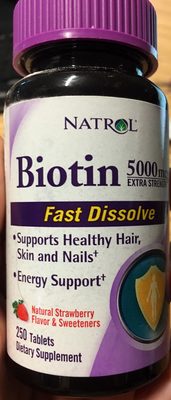
biotin
Labels
 Not computed
 Ultra-processed food and drink products
 Not computed
Health
Nutrition
Nutrient levels
Fat in low quantity (0%)
Saturated fat in low quantity (0%)
Sugars in low quantity (0%)
Salt in low quantity (0%)
Nutrition label

Nutrition facts
| Nutrition facts | As sold for 100 g / 100 ml |
|---|---|
| Energy | ~ 0 kJ (0 kcal) |
| FAT | 0 g |
| Saturated fat | 0 g |
| Carbohydrates | 0 g |
| Sugars | 0 g |
| Dietary fiber | ? |
| Proteins | 0 g |
| Salt | 0 g |
| Sodium | 0 g |
| Minerals | |
| Fruits, vegetables and legumes | ~ 0.09 % |
Nutrition facts (Detailed data)
| Nutrition facts | As sold for 100 g / 100 ml | As sold Per 100 g (packaging) | As sold Per 100 g (estimate) |
|---|---|---|---|
| Energy | ~ 0 kJ (0 kcal) | ? (0 kcal) | ? |
| FAT | 0 g | 0 g | ? |
| Saturated fat | 0 g | 0 g | ? |
| Carbohydrates | 0 g | 0 g | ? |
| Sugars | 0 g | 0 g | ? |
| Added sugars | ~ 0 g | ? | ~ 0 g |
| Dietary fiber | ? | ? | ? |
| Proteins | 0 g | 0 g | ? |
| Salt | 0 g | 0 g | ? |
| Sodium | 0 g | 0 g | ? |
| Minerals | |||
| Fruits, vegetables and legumes | ~ 0.09 % | ? | ~ 0.09 % |
Ingredients
Ingredients image
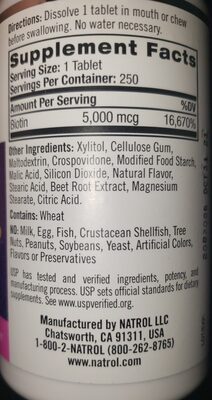
Ingredients list
Ingredient information
Allergens
Ingredients analysis
No ingredients containing palm oil.
Vegan status unknown
Vegetarian status unknown
Food Processing
NOVA group
Ultra-processed food and drink productsElements that indicate the product is in NOVA group 4
How NOVA works
Additives
E1202 - PolyvinylpolypyrrolidoneStabiliser
Polyvinylpolypyrrolidone (polyvinyl polypyrrolidone, PVPP, crospovidone, crospolividone or E1202) is a highly cross-linked modification of polyvinylpyrrolidone (PVP). The cross-linked form of PVP is used as a disintegrant (see also excipients) in pharmaceutical tablets. PVPP is a highly cross-linked version of PVP, making it insoluble in water, though it still absorbs water and swells very rapidly generating a swelling force. This property makes it useful as a disintegrant in tablets. PVPP can be used as a drug, taken as a tablet or suspension to absorb compounds (so-called endotoxins) that cause diarrhoea. (Cf. bone char, charcoal.) It is also used as a fining to extract impurities (via agglomeration followed by filtration). It is used in winemaking. Using the same principle it is used to remove polyphenols in beer production and thus clear beers with stable foam are produced. One such commercial product is called Polyclar. PVPP forms bonds similar to peptidic bonds in protein (especially, like proline residues) and that is why it can precipitate tannins the same way as proteins do.PVPP has E number code E1202 and is used as a stabiliser.
E296 - Malic acid
MALIC ACID is an organic compound with the molecular formula C4H6O5. Malic acid has two stereoisomeric forms (L- and D-enantiomers), though only the L-isomer exists naturally.
E330 - Citric acidAntioxidantSequestrant
Citric acid is a natural organic acid found in citrus fruits such as lemons, oranges, and limes.
It is widely used in the food industry as a flavor enhancer, acidulant, and preservative due to its tart and refreshing taste.
Citric acid is safe for consumption when used in moderation and is considered a generally recognized as safe (GRAS) food additive by regulatory agencies worldwide.
E466 - Sodium carboxy methyl celluloseEmulsifierHumectantStabiliserThickener
Carboxymethyl cellulose (CMC) or cellulose gum or tylose powder is a cellulose derivative with carboxymethyl groups (-CH2-COOH) bound to some of the hydroxyl groups of the glucopyranose monomers that make up the cellulose backbone. It is often used as its sodium salt, sodium carboxymethyl cellulose.
E570 - Fatty acids
In chemistry, particularly in biochemistry, a fatty acid is a carboxylic acid with a long aliphatic chain, which is either saturated or unsaturated. Most naturally occurring fatty acids have an unbranched chain of an even number of carbon atoms, from 4 to 28. Fatty acids are usually not found per se in organisms, but instead as three main classes of esters: triglycerides, phospholipids, and cholesterol esters. In any of these forms, fatty acids are both important dietary sources of fuel for animals and they are important structural components for cells.
E572 - Magnesium stearate
Magnesium stearate is the chemical compound with the formula Mg(C18H35O2)2. It is a soap, consisting of salt containing two equivalents of stearate (the anion of stearic acid) and one magnesium cation (Mg2+). Magnesium stearate is a white, water-insoluble powder. Its applications exploit its softness, insolubility in many solvents, and low toxicity. It is used as a release agent and as a component or lubricant in the production of pharmaceuticals and cosmetics.
E967 - XylitolEmulsifierHumectantStabiliserSweetenerThickener
Xylitol is a sugar alcohol used as a sweetener. The name derives from Ancient Greek: ξύλον, xyl[on], "wood" + suffix -itol, used to denote sugar alcohols. Xylitol is categorized as a polyalcohol or sugar alcohol (specifically an alditol). It has the formula CH2OH(CHOH)3CH2OH. It is a colorless or white solid that is soluble in water. Use of manufactured products containing xylitol may reduce tooth decay.
Environment
Environmental score label
Not computedCarbon footprint
No carbon footprint data is available for this product.
Packaging
No packaging information provided.
Transportation and origins
Origins of ingredients
No origin information provided.
Manufacturing places
No manufacturing place information provided.
Environmental labels
No environmental labels identified.
Data Source
Data presented on this page is sourced from the Open Food Facts database. This platform does not alter the original dataset; its purpose is solely to enhance data visualization and user accessibility.
Product added on August 15, 2017 at 4:02:38 PM UTC by openfoodfacts-contributors .
Last edit on March 17, 2026 at 12:28:08 PM UTC by new-nutrition-bot .
Product page also edited by cvettellina, inf, keragui, kiliweb, new-nutrition-bot, openfoodfacts-contributors, yuka.BLZOYfW5NtQrPfXNyYM6wzeiEbrZUv1aI2cwog.