
Dunkin' Donuts, Coffee Creamer, Vanilla
Labels
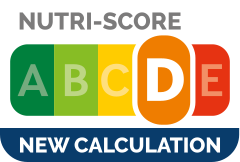 Poor nutritional quality
 Ultra-processed food and drink products
 Not computed
Health
Nutrition
Poor nutritional qualityNutrient levels
Fat in moderate quantity (11.1%)
Saturated fat in low quantity (0%)
Sugars in high quantity (33.3%)
Salt in low quantity (0%)
Physical activities
Approximate time needed to burn the energy in 100 g / 100 ml: 3,887 kJ. Reference adult weight: 70 kg. Energy density: High.
Nutrition facts
| Nutrition facts | As sold for 100 g / 100 ml |
|---|---|
| Energy | 929 kcal (222 kcal) |
| FAT | 11.11 g |
| Saturated fat | 0 g |
| Monounsaturated FAT | 0 g |
| Polyunsaturated FAT | 0 g |
| Trans fat | 0 g |
| Cholesterol | 0 mg |
| Carbohydrates | 33.33 g |
| Sugars | 33.33 g |
| Dietary fiber | 0 g |
| Proteins | 0 g |
| Salt | 0 mg |
| Sodium | 0 mg |
| Vitamins | |
| Vitamin A | 0 IU |
| Vitamin C | 0 mg |
| Minerals | |
| Calcium | 0.22 mg |
| Iron | 0 mg |
| Fruits, vegetables and legumes | ? |
Nutrition facts (Detailed data)
| Nutrition facts | As sold for 100 g / 100 ml | As sold Per serving (legacy) |
|---|---|---|
| Energy | 929 kcal (222 kcal) | 83.6 kcal (20 kcal) |
| FAT | 11.11 g | 1 g |
| Saturated fat | 0 g | 0 g |
| Monounsaturated FAT | 0 g | 0 g |
| Polyunsaturated FAT | 0 g | 0 g |
| Trans fat | 0 g | 0 g |
| Cholesterol | 0 mg | 0 mg |
| Carbohydrates | 33.33 g | 3 g |
| Sugars | 33.33 g | 3 g |
| Dietary fiber | 0 g | 0 g |
| Proteins | 0 g | 0 g |
| Salt | 0 mg | 0 mg |
| Sodium | 0 mg | 0 mg |
| Vitamins | ||
| Vitamin A | 0 IU | 0 IU |
| Vitamin C | 0 mg | 0 mg |
| Minerals | ||
| Calcium | 0.22 mg | 0.02 mg |
| Iron | 0 mg | 0 mg |
| Fruits, vegetables and legumes | ? | ? |
Serving size
Ingredients list
Ingredient information
Allergens
NOVA group
Ultra-processed food and drink productsElements that indicate the product is in NOVA group 4
How NOVA works
Ingredients analysis
Contains ingredients containing palm oil.
Contains non-vegan ingredients.
Unrecognized: en:contains-2-and-less-of, en:a-milk-derivative
Vegetarian status unknown
Unrecognized: en:contains-2-and-less-of, en:a-milk-derivative
Additives
E340 - Potassium phosphatesEmulsifierHumectantSequestrantStabiliserThickener
Potassium phosphate is a generic term for the salts of potassium and phosphate ions including: Monopotassium phosphate (KH2PO4) (Molar mass approx: 136 g/mol) Dipotassium phosphate (K2HPO4) (Molar mass approx: 174 g/mol) Tripotassium phosphate (K3PO4) (Molar mass approx: 212.27 g/mol)As food additives, potassium phosphates have the E number E340.
E340ii - Dipotassium phosphateEmulsifierHumectantSequestrantStabiliserThickener
No additive description is available yet.
E407 - CarrageenanCarrierEmulsifierHumectantStabiliserThickener
Carrageenan (E407), derived from red seaweed, is widely employed in the food industry as a gelling, thickening, and stabilizing agent, notably in dairy and meat products.
It can exist in various forms, each imparting distinct textural properties to food.
However, its degraded form, often referred to as poligeenan, has raised health concerns due to its potential inflammatory effects and its classification as a possible human carcinogen (Group 2B) by the International Agency for Research on Cancer (IARC).
Nevertheless, food-grade carrageenan has been deemed safe by various regulatory bodies when consumed in amounts typically found in food.
E471 - Mono- and diglycerides of fatty acidsEmulsifierStabiliser
Mono- and diglycerides of fatty acids (E471), are food additives commonly used as emulsifiers in various processed foods.
These compounds consist of glycerol molecules linked to one or two fatty acid chains, which help stabilize and blend water and oil-based ingredients. E471 enhances the texture and shelf life of products like margarine, baked goods, and ice cream, ensuring a smooth and consistent texture.
It is generally considered safe for consumption within established regulatory limits.
E481 - Sodium stearoyl-2-lactylateEmulsifierStabiliser
Sodium stearoyl-2-lactylate (sodium stearoyl lactylate or SSL) is a versatile, FDA approved food additive used to improve the mix tolerance and volume of processed foods. It is one type of a commercially available lactylate. SSL is non-toxic, biodegradable, and typically manufactured using biorenewable feedstocks. Because SSL is a safe and highly effective food additive, it is used in a wide variety of products ranging from baked goods and desserts to pet foods.As described by the Food Chemicals Codex 7th edition, SSL is a cream-colored powder or brittle solid. SSL is currently manufactured by the esterification of stearic acid with lactic acid and partially neutralized with either food-grade soda ash (sodium carbonate) or caustic soda (concentrated sodium hydroxide). Commercial grade SSL is a mixture of sodium salts of stearoyl lactylic acids and minor proportions of other sodium salts of related acids. The HLB for SSL is 10-12. SSL is slightly hygroscopic, soluble in ethanol and in hot oil or fat, and dispersible in warm water. These properties are the reason that SSL is an excellent emulsifier for fat-in-water emulsions and can also function as a humectant.
Environment
Environment
Environmental score
 Unknown environmental impact
Threatened species
Data Source
Product added on March 10, 2017 at 11:11:46 AM UTC by usda-ndb-import .
Last edit on April 23, 2020 at 10:01:17 AM UTC by org-database-usda .
Product page also edited by usda-ndb-import, org-database-usda.
Source List
- usda-ndb
- database-usda