

Four Cheese Mashed Potatoes
Labels
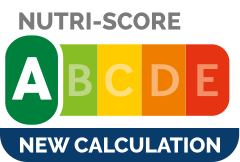 Very good nutritional quality
 Ultra-processed food and drink products
 Not computed
Health
Nutrition
Label
Very good nutritional qualityNutrient levels
Fat in low quantity (1.79%)
Saturated fat in low quantity (1.07%)
Sugars in low quantity (1.43%)
Salt in moderate quantity (1.04%)
Nutrition label

Nutrition facts
| Nutrition facts | Prepared for 100 g / 100 ml |
|---|---|
| Energy | 328.74 kJ (79 kcal) |
| FAT | 1.79 g |
| Saturated fat | 1.07 g |
| Trans fat | 0 g |
| Cholesterol | 0 g |
| Carbohydrates | 13.57 g |
| Sugars | 1.43 g |
| Dietary fiber | 0.71 g |
| Proteins | 2.14 g |
| Salt | 1.04 g |
| Sodium | 0.41 g |
| Vitamins | |
| Vitamin A | 0 g |
| Minerals | |
| Potassium | 0.19 g |
| Calcium | 0.04 g |
| Iron | 0 g |
| Fruits, vegetables and legumes | ? |
Nutrition facts (Detailed data)
| Nutrition facts | Prepared for 100 g / 100 ml | Prepared Per serving (140 g) (packaging) | As sold Per 100 g (packaging) | As sold Per serving (140 g) (packaging) | As sold Per 100 g (estimate) |
|---|---|---|---|---|---|
| Energy | 328.74 kJ (79 kcal) | 460.24 kJ (110 kcal) | ? (393 kcal) | ? (110 kcal) | ? |
| FAT | 1.79 g | 2.5 g | ? | 2.5 g | ? |
| Saturated fat | 1.07 g | 1.5 g | ? | 1 g | ? |
| Trans fat | 0 g | 0 g | ? | ? | ? |
| Cholesterol | 0 g | 0.01 g | ? | 0.01 g | ? |
| Carbohydrates | 13.57 g | 19 g | ? | 19 g | ? |
| Sugars | 1.43 g | 2 g | ? | 2 g | ? |
| Added sugars | ? | ? | ? | 1 g | ~ 1.45 g |
| Starch | ? | ? | ? | 0 g | ? |
| Dietary fiber | 0.71 g | 1 g | ? | 1 g | ? |
| Proteins | 2.14 g | 3 g | ? | 3 g | ? |
| Salt | 1.04 g | 1.45 g | ? | 1.45 g | ? |
| Sodium | 0.41 g | 0.58 g | ? | 0.58 g | ? |
| Vitamins | |||||
| Vitamin A | 0 g | 0 g | ? | ? | ? |
| Vitamin D | ? | ? | ? | 0 g | ? |
| Minerals | |||||
| Potassium | 0.19 g | 0.27 g | ? | 0.27 g | ? |
| Calcium | 0.04 g | 0.05 g | ? | 0.05 g | ? |
| Iron | 0 g | 0 g | 1.43 mg | 0 g | ? |
| Fruits, vegetables and legumes | ? | ? | ? | ? | ~ 1.88 % |
| Choline | ? | ? | ? | 0 g | ? |
Serving size
Estimated Activity Time
Approximate time needed to burn the energy in 100 g / 100 ml: 329 kJ. Reference adult weight: 70 kg. Energy density: Low.
Ingredients
Ingredients image
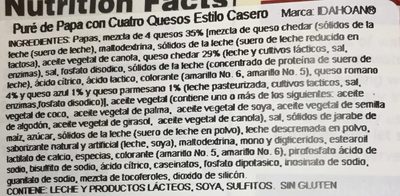
Ingredients list
Ingredient information
Allergens
Ingredients analysis
Contains ingredients containing palm oil.
Contains non-vegan ingredients.
Unrecognized: en:idaho-potatoes, en:cheddar-cheese-blend, en:reduced-lactose-whey, en:e339ii, en:5, en:e339ii, en:calcium-stearoyl-lactylate, en:6, en:preserve-freshness, en:preserve-freshness, en:preserve-freshness, en:preserve-freshness, en:less-than-2-silicon-dioxide-added-as-an-anti-caking-agent
Vegetarian status unknown
Unrecognized: en:idaho-potatoes, en:cheddar-cheese-blend, en:reduced-lactose-whey, en:e339ii, en:5, en:e339ii, en:calcium-stearoyl-lactylate, en:6, en:preserve-freshness, en:preserve-freshness, en:preserve-freshness, en:preserve-freshness, en:less-than-2-silicon-dioxide-added-as-an-anti-caking-agent
Food Processing
NOVA group
Ultra-processed food and drink productsElements that indicate the product is in NOVA group 4
How NOVA works
Additives
E270 - Lactic acid
LACTIC ACID is an organic compound with the formula CH3CH(OH)CO2H. In the form of its conjugate base called lactate (this is thus different and kept as a separate ingredient). Lactic acid is chiral, consisting of two optical isomers. One is known as L-(+)-lactic acid or (S)-lactic acid and the other, its mirror image, is D-(−)-lactic acid or (R)-lactic acid in food the L-variant is used
E306 - Tocopherol-rich extract
No additive description is available yet.
E330 - Citric acidAntioxidantSequestrant
Citric acid is a natural organic acid found in citrus fruits such as lemons, oranges, and limes.
It is widely used in the food industry as a flavor enhancer, acidulant, and preservative due to its tart and refreshing taste.
Citric acid is safe for consumption when used in moderation and is considered a generally recognized as safe (GRAS) food additive by regulatory agencies worldwide.
E339ii - Disodium phosphateEmulsifierHumectantPreservativeSequestrantStabiliserThickener
No additive description is available yet.
E340 - Potassium phosphatesEmulsifierHumectantSequestrantStabiliserThickener
Potassium phosphate is a generic term for the salts of potassium and phosphate ions including: Monopotassium phosphate (KH2PO4) (Molar mass approx: 136 g/mol) Dipotassium phosphate (K2HPO4) (Molar mass approx: 174 g/mol) Tripotassium phosphate (K3PO4) (Molar mass approx: 212.27 g/mol)As food additives, potassium phosphates have the E number E340.
E340ii - Dipotassium phosphateEmulsifierHumectantSequestrantStabiliserThickener
No additive description is available yet.
E450 - DiphosphatesEmulsifierHumectantSequestrantStabiliserThickener
Diphosphates (E450) are food additives often utilized to modify the texture of products, acting as leavening agents in baking and preventing the coagulation of canned food.
These salts can stabilize whipped cream and are also found in powdered products to maintain their flow properties. They are commonly present in baked goods, processed meats, and soft drinks.
Derived from phosphoric acid, they're part of our daily phosphate intake, which often surpasses recommended levels due to the prevalence of phosphates in processed foods and drinks.
Excessive phosphate consumption is linked to health issues, such as impaired kidney function and weakened bone health. Though diphosphates are generally regarded as safe when consumed within established acceptable daily intakes, it's imperative to monitor overall phosphate consumption to maintain optimal health.
E450i - Disodium diphosphateEmulsifierHumectantSequestrantStabiliserThickener
No additive description is available yet.
E471 - Mono- and diglycerides of fatty acidsEmulsifierStabiliser
Mono- and diglycerides of fatty acids (E471), are food additives commonly used as emulsifiers in various processed foods.
These compounds consist of glycerol molecules linked to one or two fatty acid chains, which help stabilize and blend water and oil-based ingredients. E471 enhances the texture and shelf life of products like margarine, baked goods, and ice cream, ensuring a smooth and consistent texture.
It is generally considered safe for consumption within established regulatory limits.
E627 - Disodium guanylate
Disodium guanylate, also known as sodium 5'-guanylate and disodium 5'-guanylate, is a natural sodium salt of the flavor enhancing nucleotide guanosine monophosphate (GMP). Disodium guanylate is a food additive with the E number E627. It is commonly used in conjunction with glutamic acid. As it is a fairly expensive additive, it is not used independently of glutamic acid; if disodium guanylate is present in a list of ingredients but MSG does not appear to be, it is likely that glutamic acid is provided as part of another ingredient such as a processed soy protein complex. It is often added to foods in conjunction with disodium inosinate; the combination is known as disodium 5'-ribonucleotides. Disodium guanylate is produced from dried seaweed and is often added to instant noodles, potato chips and other snacks, savory rice, tinned vegetables, cured meats, and packaged soup.
E631 - Disodium inosinate
Disodium inosinate (E631) is the disodium salt of inosinic acid with the chemical formula C10H11N4Na2O8P. It is used as a food additive and often found in instant noodles, potato chips, and a variety of other snacks. Although it can be obtained from bacterial fermentation of sugars, it is often commercially prepared from animal sources.
Environment
Packaging
Packaging details
Transportation and origins
Data Source
Data presented on this page is sourced from the Open Food Facts database. This platform does not alter the original dataset; its purpose is solely to enhance data visualization and user accessibility.
Product added on March 9, 2017 at 12:07:02 PM UTC by usda-ndb-import .
Last edit on March 17, 2026 at 2:31:08 PM UTC by macrofactor .
Product page also edited by inf, lukasday, macrofactor, municorn-calorie-counter-app, openfoodfacts-contributors, openfoodfactsmx5, org-database-usda, packbot, roboto-app, stephane, usda-ndb-import.
Source List
- usda-ndb
- database-usda