
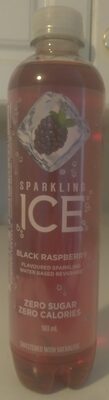
Black Raspberry Sparkling Ice
Health
Nutrition
Nutri-Score
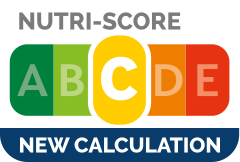 Average nutritional quality
Nutri-Score data warning
Nutrient levels
Fat in low quantity (0%)
Saturated fat in low quantity (0%)
Sugars in low quantity (0%)
Salt in low quantity (0.00497%)
Nutrition label
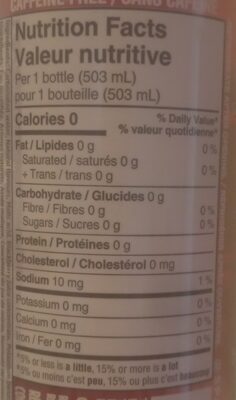
Nutrition facts
| Nutrition facts | As sold for 100 ml | Compared to: Soft drinks |
|---|---|---|
| Energy | ~ 0 kJ (0 kcal) | 106.754 kJ (25 kcal) (-100%) |
| Fat | 0 g | 0.028 g (-100%) |
| Saturated fat | 0 g | 0.007 g (-100%) |
| Trans fat | 0 g | 0 g |
| Cholesterol | 0 g | 0 mg |
| Carbohydrates | 0 g | 6.132 g (-100%) |
| Sugars | 0 g | 5.995 g (-100%) |
| Dietary fiber | 0 g | ? |
| Proteins | 0 g | 0.043 g (-100%) |
| Salt | 0.00497017892644135 g | 0.016 g (-69%) |
| Sodium | 0.00198807157057654 g | 0.007 g (-72%) |
| Potassium | 0 g | 14.15 mg (-100%) |
| Calcium | 0 g | 7.45 mg (-100%) |
| Iron | 0 g | 0.041 mg (-100%) |
| Fruits, vegetables and legumes | ~ 2.5 % | ? |
Nutrition facts (Detailed data)
| Nutrition facts | As sold for 100 ml | As sold Per serving (503 ml) (packaging) | As sold Per 100 g (estimate) |
|---|---|---|---|
| Energy | ~ 0 kJ (0 kcal) | ? (0 kcal) | ? |
| Fat | 0 g | 0 g | ? |
| Saturated fat | 0 g | 0 g | ? |
| Trans fat | 0 g | 0 g | ? |
| Cholesterol | 0 g | 0 g | ? |
| Carbohydrates | 0 g | 0 g | ? |
| Sugars | 0 g | 0 g | ? |
| Dietary fiber | 0 g | 0 g | ? |
| Proteins | 0 g | 0 g | ? |
| Salt | 0.00497017892644135 g | 0.025 g | ? |
| Sodium | 0.00198807157057654 g | 0.01 g | ? |
| Potassium | 0 g | 0 g | ? |
| Calcium | 0 g | 0 g | ? |
| Iron | 0 g | 0 g | ? |
| Fruits, vegetables and legumes | ~ 2.5 % | ? | ~ 2.5 % |
Serving size
Ingredients
Ingredients image

Ingredients list
Ingredient information
Ingredients analysis
No ingredients containing palm oil.
Vegan status unknown
Vegetarian status unknown
Food Processing
NOVA group
 Ultra-processed food and drink products
Elements that indicate the product is in NOVA group 4
How NOVA works
Additives
E129 - Allura red EFSA overexposure risk: noColour
Allura Red AC is a red azo dye that goes by several names, including FD&C Red 40. It is used as a food dye and has the E number E129. It is usually supplied as its red sodium salt, but can also be used as the calcium and potassium salts. These salts are soluble in water. In solution, its maximum absorbance lies at about 504 nm.
E212 - Potassium benzoate EFSA overexposure risk: highPreservative
Potassium benzoate (E212), the potassium salt of benzoic acid, is a food preservative that inhibits the growth of mold, yeast and some bacteria. It works best in low-pH products, below 4.5, where it exists as benzoic acid. Acidic foods and beverages such as fruit juice (citric acid), sparkling drinks (carbonic acid), soft drinks (phosphoric acid), pickles (vinegar), and frogurt toppings may be preserved with potassium benzoate. It is approved for use in most countries including Canada, the U.S., and the EU, where it is designated by the E number E212. Potassium benzoate is also used in the whistle in many fireworks.
E296 - Malic acid
MALIC ACID is an organic compound with the molecular formula C4H6O5. Malic acid has two stereoisomeric forms (L- and D-enantiomers), though only the L-isomer exists naturally.
E955 - SucraloseSweetener
Sucralose is an artificial sweetener and sugar substitute. The majority of ingested sucralose is not broken down by the body, so it is noncaloric. In the European Union, it is also known under the E number E955. It is produced by chlorination of sucrose. Sucralose is about 320 to 1,000 times sweeter than sucrose, three times as sweet as both aspartame and acesulfame potassium, and twice as sweet as sodium saccharin. Evidence of benefit is lacking for long-term weight loss with some data supporting weight gain and heart disease risks.It is stable under heat and over a broad range of pH conditions. Therefore, it can be used in baking or in products that require a long shelf life. The commercial success of sucralose-based products stems from its favorable comparison to other low-calorie sweeteners in terms of taste, stability, and safety. Common brand names of sucralose-based sweeteners are Splenda, Zerocal, Sukrana, SucraPlus, Candys, Cukren, and Nevella. Canderel Yellow also contains sucralose, but the original Canderel and Green Canderel do not.
Environment
Green-Score, origins bonus, and transportation impact are shown for Worldwide .
Green Score
Overall grade
About Green-Score
Current scope
Green-Score availability
Bonuses and maluses
Declared origins
Packaging impact
Packaging
Packaging impact
Packaging components
| Shape | Material | Recycling | Impact |
|---|---|---|---|
| Bottle | Unknown | Unknown | High |
Declared packaging
Data precision
Transportation
Manufacturing locations
Declared origins
Forest footprint
Forest footprint
Deforestation risk details
Data Source
Product data comes from Open Food Facts. Food Benchmark also adds translations, category comparisons and explanatory calculations.
The database is licensed under ODbL 1.0, individual contents under DbCL 1.0, and product photos under CC BY-SA 3.0.
Product added on March 16, 2019 at 9:57:15 PM UTC by kiliweb .
Last edit on March 17, 2026 at 10:51:44 PM UTC by new-nutrition-bot .
Product page also edited by anonymous-s7co2zv64u, autorotate-bot, kiliweb, micromonde, new-nutrition-bot, openfoodfacts-contributors, teolemon, yuka.V1A4ZEU1VmRqOHRXaGN3RnprTDZ4Y3hONjd1SFR6KzRBTzAxSVE9PQ.