
Roundy's, sparkling water, wild cherry
Labels
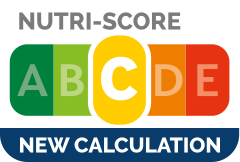 Moderate nutritional quality
 Ultra-processed food and drink products
Health
Nutrition
Label
Moderate nutritional qualityNutrient levels
Fat in low quantity (0%)
Sugars in low quantity (0%)
Salt in low quantity (0.005%)
Nutrition facts
| Nutrition facts | As sold for 100 g / 100 ml |
|---|---|
| Energy | 0 kcal (0 kcal) |
| FAT | 0 g |
| Saturated fat | ? |
| Carbohydrates | 0 g |
| Sugars | 0 g |
| Dietary fiber | ? |
| Proteins | 0 g |
| Salt | 0.01 mg |
| Sodium | 0 mg |
| Minerals | |
| Fruits, vegetables and legumes | ? |
Nutrition facts (Detailed data)
| Nutrition facts | As sold for 100 g / 100 ml | As sold Per serving (legacy) |
|---|---|---|
| Energy | 0 kcal (0 kcal) | 0 kcal (0 kcal) |
| FAT | 0 g | 0 g |
| Saturated fat | ? | ? |
| Carbohydrates | 0 g | 0 g |
| Sugars | 0 g | 0 g |
| Dietary fiber | ? | ? |
| Proteins | 0 g | 0 g |
| Salt | 0.01 mg | 0.01 mg |
| Sodium | 0 mg | 0 mg |
| Minerals | ||
| Fruits, vegetables and legumes | ? | ? |
Serving size
Ingredients
Ingredients list
Ingredient information
Ingredients analysis
No ingredients containing palm oil.
Vegan status unknown
Vegetarian status unknown
Food Processing
NOVA group
Ultra-processed food and drink productsElements that indicate the product is in NOVA group 4
How NOVA works
Additives
E212 - Potassium benzoatePreservative
Potassium benzoate (E212), the potassium salt of benzoic acid, is a food preservative that inhibits the growth of mold, yeast and some bacteria. It works best in low-pH products, below 4.5, where it exists as benzoic acid. Acidic foods and beverages such as fruit juice (citric acid), sparkling drinks (carbonic acid), soft drinks (phosphoric acid), pickles (vinegar), and frogurt toppings may be preserved with potassium benzoate. It is approved for use in most countries including Canada, the U.S., and the EU, where it is designated by the E number E212. Potassium benzoate is also used in the whistle in many fireworks.
E296 - Malic acid
MALIC ACID is an organic compound with the molecular formula C4H6O5. Malic acid has two stereoisomeric forms (L- and D-enantiomers), though only the L-isomer exists naturally.
E330 - Citric acidAntioxidantSequestrant
Citric acid is a natural organic acid found in citrus fruits such as lemons, oranges, and limes.
It is widely used in the food industry as a flavor enhancer, acidulant, and preservative due to its tart and refreshing taste.
Citric acid is safe for consumption when used in moderation and is considered a generally recognized as safe (GRAS) food additive by regulatory agencies worldwide.
E950 - Acesulfame kSweetener
Acesulfame potassium ( AY-see-SUL-faym), also known as acesulfame K (K is the symbol for potassium) or Ace K, is a calorie-free sugar substitute (artificial sweetener) often marketed under the trade names Sunett and Sweet One. In the European Union, it is known under the E number (additive code) E950. It was discovered accidentally in 1967 by German chemist Karl Clauss at Hoechst AG (now Nutrinova). In chemical structure, acesulfame potassium is the potassium salt of 6-methyl-1,2,3-oxathiazine-4(3H)-one 2,2-dioxide. It is a white crystalline powder with molecular formula C4H4KNO4S and a molecular weight of 201.24 g/mol.
E955 - SucraloseSweetener
Sucralose is an artificial sweetener and sugar substitute. The majority of ingested sucralose is not broken down by the body, so it is noncaloric. In the European Union, it is also known under the E number E955. It is produced by chlorination of sucrose. Sucralose is about 320 to 1,000 times sweeter than sucrose, three times as sweet as both aspartame and acesulfame potassium, and twice as sweet as sodium saccharin. Evidence of benefit is lacking for long-term weight loss with some data supporting weight gain and heart disease risks.It is stable under heat and over a broad range of pH conditions. Therefore, it can be used in baking or in products that require a long shelf life. The commercial success of sucralose-based products stems from its favorable comparison to other low-calorie sweeteners in terms of taste, stability, and safety. Common brand names of sucralose-based sweeteners are Splenda, Zerocal, Sukrana, SucraPlus, Candys, Cukren, and Nevella. Canderel Yellow also contains sucralose, but the original Canderel and Green Canderel do not.
Environment
Green-Score, origins bonus, and transportation impact are shown for Worldwide .
Green Score
Overall grade
About Green-Score
Current scope
Green-Score availability
Bonuses and maluses
Declared origins
Packaging impact
Packaging
Packaging impact
Data precision
Transportation
Declared origins
Data Source
Data presented on this page is sourced from the Open Food Facts database. This platform does not alter the original dataset; its purpose is solely to enhance data visualization and user accessibility.
Product added on March 9, 2017 at 3:04:10 PM UTC by usda-ndb-import .
Last edit on April 22, 2020 at 7:52:21 PM UTC by org-database-usda .
Product page also edited by usda-ndb-import, org-database-usda.
Source List
- usda-ndb
- database-usda