
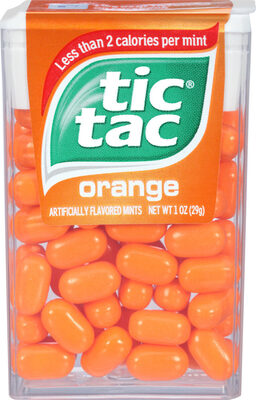
Tic Tac Orange
Labels
 Not computed
 Ultra-processed food and drink products
 High environmental impact
Health
Nutrition
Nutrition label
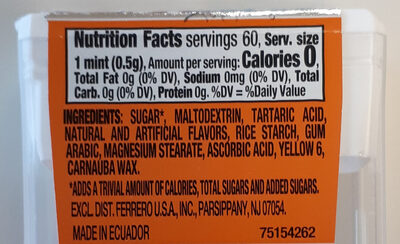
Nutrition facts
| Nutrition facts | As sold for 100 g / 100 ml |
|---|---|
| Energy | ? |
| FAT | ? |
| Saturated fat | ? |
| Carbohydrates | ? |
| Sugars | ? |
| Dietary fiber | ? |
| Proteins | ? |
| Salt | ? |
| Minerals | |
| Fruits, vegetables and legumes | ? |
Nutrition facts (Detailed data)
| Nutrition facts | As sold for 100 g / 100 ml | As sold Per serving (legacy) |
|---|---|---|
| Energy | ? | 8 kcal (2 kcal) |
| FAT | ? | 0 g |
| Saturated fat | ? | ? |
| Carbohydrates | ? | 0 g |
| Sugars | ? | ? |
| Dietary fiber | ? | ? |
| Proteins | ? | 0 g |
| Salt | ? | ? |
| Minerals | ||
| Fruits, vegetables and legumes | ? | ? |
Serving size
Ingredients
Ingredients list
Ingredient information
Ingredients analysis
No ingredients containing palm oil.
Vegan status unknown
Vegetarian status unknown
Food Processing
NOVA group
Ultra-processed food and drink productsElements that indicate the product is in NOVA group 4
How NOVA works
Additives
E110 - Sunset yellow FCFColour
Sunset Yellow FCF (also known as Orange Yellow S, or C.I. 15985) is a petroleum-derived orange azo dye with a pH dependent maximum absorption at about 480 nm at pH 1 and 443 nm at pH 13 with a shoulder at 500 nm. When added to foods sold in the US it is known as FD&C Yellow 6; when sold in Europe, it is denoted by E Number E110.
E334 - L(+)-tartaric acidAntioxidantSequestrant
TARTARIC ACID is a white, crystalline organic acid that occurs naturally in many fruits, most notably in grapes, but also in bananas, tamarinds, and citrus
E414 - Acacia gumCarrierEmulsifierStabiliserThickener
Gum arabic, also known as acacia gum, arabic gum, gum acacia, acacia, Senegal gum and Indian gum, and by other names, is a natural gum consisting of the hardened sap of various species of the acacia tree. Originally, gum arabic was collected from Acacia nilotica which was called the "gum arabic tree"; in the present day, gum arabic is collected from acacia species, predominantly Acacia senegal and Vachellia (Acacia) seyal; the term "gum arabic" does not indicate a particular botanical source. In a few cases so‐called "gum arabic" may not even have been collected from Acacia species, but may originate from Combretum, Albizia or some other genus. Producers harvest the gum commercially from wild trees, mostly in Sudan (80%) and throughout the Sahel, from Senegal to Somalia—though it is historically cultivated in Arabia and West Asia. Gum arabic is a complex mixture of glycoproteins and polysaccharides. It is the original source of the sugars arabinose and ribose, both of which were first discovered and isolated from it, and are named after it. Gum arabic is soluble in water. It is edible, and used primarily in the food industry as a stabilizer, with EU E number E414. Gum arabic is a key ingredient in traditional lithography and is used in printing, paint production, glue, cosmetics and various industrial applications, including viscosity control in inks and in textile industries, though less expensive materials compete with it for many of these roles. While gum arabic is now produced throughout the African Sahel, it is still harvested and used in the Middle East.
E572 - Magnesium stearate
Magnesium stearate is the chemical compound with the formula Mg(C18H35O2)2. It is a soap, consisting of salt containing two equivalents of stearate (the anion of stearic acid) and one magnesium cation (Mg2+). Magnesium stearate is a white, water-insoluble powder. Its applications exploit its softness, insolubility in many solvents, and low toxicity. It is used as a release agent and as a component or lubricant in the production of pharmaceuticals and cosmetics.
E903 - Carnauba waxCarrier
Carnauba (; Portuguese: carnaúba [kaʁnɐˈubɐ]), also called Brazil wax and palm wax, is a wax of the leaves of the palm Copernicia prunifera (Synonym: Copernicia cerifera), a plant native to and grown only in the northeastern Brazilian states of Piauí, Ceará, Maranhão, Bahia, and Rio Grande do Norte. It is known as "queen of waxes" and in its pure state, usually comes in the form of hard yellow-brown flakes. It is obtained from the leaves of the carnauba palm by collecting and drying them, beating them to loosen the wax, then refining and bleaching the wax.
Environment
Green-Score, origins bonus, and transportation impact are shown for Worldwide .
Green Score
Overall grade
High environmental impactAbout Green-Score
Current scope
Life cycle analysis
Average impact of the category
 Candies, all types • Score: 62/100
Life-cycle reference
Overall environmental impact by stage (PEF)
The overall environmental impact figure (PEF) comes from ADEME's Agribalyse database, for the category: Candies, all types. Source: ADEME Agribalyse Database.
| Stage | Impact |
|---|---|
| Agriculture | 78.2 % |
| Processing | 10.6 % |
| Packaging | 5.5 % |
| Transportation | 4.5 % |
| Distribution | 1.1 % |
| Consumption | 0.0 % |
Bonuses and maluses
Declared origins
Packaging impact
Green-Score for this product
Green-Score for this product
Final score: 42/100Final score breakdown
Carbon footprint
Carbon footprint
Climate impact by stage (CO2e)
The carbon emission figure comes from ADEME's Agribalyse database, for the category: Candies, all types. Source: ADEME Agribalyse Database.
| Stage | Impact |
|---|---|
| Agriculture | 52.2 % |
| Processing | 19.5 % |
| Packaging | 15.7 % |
| Transportation | 11.6 % |
| Distribution | 1.0 % |
| Consumption | 0.0 % |
Packaging
Packaging impact
Data precision
Transportation
Declared origins
Data Source
Data presented on this page is sourced from the Open Food Facts database. This platform does not alter the original dataset; its purpose is solely to enhance data visualization and user accessibility.
Product added on March 9, 2017 at 2:05:51 PM UTC by usda-ndb-import .
Last edit on May 17, 2025 at 9:19:36 PM UTC by foodless .
Product page also edited by autorotate-bot, ecoscore-impact-estimator, foodless, inf, kiliweb, macrofactor, openfoodfacts-contributors, org-database-usda, usda-ndb-import, wolfgang8741, yuka.sY2b0xO6T85zoF3NwEKvlkFbWefZpTnkbj3WmkSgw9a3PpDxQs9j4Yj4bKo, yuka.sY2b0xO6T85zoF3NwEKvlmN3dtbmoALWZxnQpHSQ5tTedrrvbftr7bjGI6s.
Source List
- usda-ndb
- database-usda